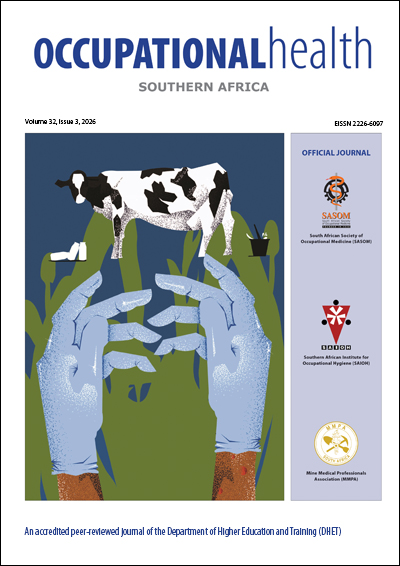
Editor-in-Chief: Gill Nelson, PhD (Occupational Health), University of the Witwatersrand, South Africa
Assistant Editor: Ntombizodwa Ndlovu, PhD (Occupational Health), University of the Witwatersrand, South Africa
Publisher: MettaMedia (Pty) Ltd
e-ISSN: 2226-6097
ISSN: 1024-6274
Frequency: 4 issues per year
Occupational Health Southern Africa is on the Department of Higher Education and Training’s list of Approved South African Journals; authors of peer-reviewed papers thus qualify for subsidies for their affiliated tertiary institutions. It is also listed in African Index Medicus; and is
on the International Committee of Medical Journal Editors (ICMJE) website list of journals following the ICMJE recommendations
for the conduct, reporting, editing and publication of scholarly work in medical journals.
Guest Editorial
Beyond the rock face: A woman’s journey in occupational hygiene
Amu Modau
Woman in Mining
Leadership, multisectoral collaboration, and institutional legacy in occupational health: Reflections on Dr Thuthula Balfour’s contribution to the South African mining sector
M Mahlangu, N Moyo
Women driving the future of underground mining
Redpath Africa Limited
Why supporting expecting mothers is mining’s next inclusion frontier
Workforce Holdings Limited
News
Envirocon Instrumentation donates a sound level meter to Wits School of Public Health
K Lebelo
Numbers that count – Tshiamiso Trust reports 64% increase in claim lodgements as mandate enters critical phase
Tshiamiso Trust
Profile
The professor who wouldn’t look away: Leslie London on poison, the ‘dop system’, and genocide
Biénne Huisman
Case Report
Latex contact dermatitis at a Free State dairy farm in South Africa and a dismissal: An occupational exposure with devastating outcome
DD Khahlane, L Makhakhe
Original Research
COVID-19 knowledge, attitude, practice, and occupational risk perception among health workers in Lesotho
M Asfaw, N Ssekandi, N Ndaba
Effectiveness of low-cost wetting methods to reduce respirable silica exposure during construction activities
D Brouwer, K Renton
Issues in Occupational Health
Small sample sizes in occupational hygiene and exposure science datasets: Implications for statistical analysis
D Brouwer
Analysis of the Globally Harmonized System of Classification and Labelling of Chemicals Requirements in the 2021 Regulations for Hazardous Chemical Agents in South Africa
W Utembe, S Kgalamono, M Zungu
Report
Artisanal and small-scale mining in Africa: Occupational health and safety challenges
D Moyo
Legislation
Watching the indicators: What the 2025 essential services designation means for tailings dam safety
Webber Wentzel
Review of occupational health and safety legislation in Zambia
K Ngosa, M Chakulimba, P Hayumbu
Marketplace
Cleansing the air: How Rensair’s hospital-grade filtration is redefining workplace air safety
Amtronix
Africa’s Integrated Protection Marketplace reflects the future of organisational resilience
A-OSH Expo South Africa
Societies